
Reacher Stephen
Difference Between AI-Powered Creator Discovery and Manual Search for TikTok Shop Campaigns
Examine the difference between AI-powered creator discovery and manual search for TikTok Shop campaigns. Compare workflows, GMV tracking, and unit economics.
difference between AI-powered creator discovery and manual search for TikTok Shop campaigns
TikTok Shop growth depends on finding creators who generate orders, not simply views. The difference between AI-powered creator discovery and manual search for TikTok Shop campaigns appears in the operating details: one relies on scattered research and cold outreach, while the other evaluates audience behavior, content signals, commerce history, and campaign fit before inventory is sent.
Key Takeaways
- TikTok Shop success comes from partnering with creators who drive actual orders, not just creators who rack up views.
- Manual search slows campaigns down because it relies on scattered research and cold outreach that rarely identifies proven sellers.
- AI-powered discovery evaluates audience behavior, content signals, and past commerce performance before a single product sample ships out.
- Matching creators to campaign fit upfront protects your budget and shortens the path from launch to revenue.
Manual discovery can consume hours each week across hashtags, sounds, profiles, and direct messages. It also creates a qualification gap. One reported benchmark found that manual outreach produced eight replies from 40 pitches, while typical response rates remain below 15% to 20% without prior commerce-signal filtering. AI provides a repeatable way to prioritize creators with stronger purchase intent and measurable sales potential.
TikTok Shop Creator Discovery: Manual Scavenger Hunt vs. Intelligent Engine
Manual TikTok creator search starts with follower count, recent views, hashtags, trending sounds, niche labels, and public bios. Those details help create a list, but rarely show whether an audience buys, whether the creator features products, or whether a campaign can meet its affiliate margin target. Teams must open profiles, watch videos, inspect comments, record contact details, and judge dozens or hundreds of candidates.
AI-powered creator discovery evaluates multiple signals together. It organizes creator attributes, analyzes content patterns, identifies product categories, and prioritizes profiles showing commercial activity. The difference between AI-powered creator discovery and manual search for TikTok Shop campaigns is not only speed. It is the move from surface prospecting to structured qualification before a sample request or affiliate invitation.
Creator fraud and weak partnerships create measurable financial costs. InfluenceFlow reports that brands lose an average of $250,000 annually to inauthentic partnerships and fraudulent followers. Reacher places discovery inside a broader growth system, including Creator Community, so qualified partners can move from contact to activation and affiliate participation. Creator Community supports Discord-based creator community management, creator activation workflows, and Community-led affiliate growth instead of leaving relationships in spreadsheets and inboxes.
The Operational Workflow Matrix: Manual Search vs. AI-Powered Discovery
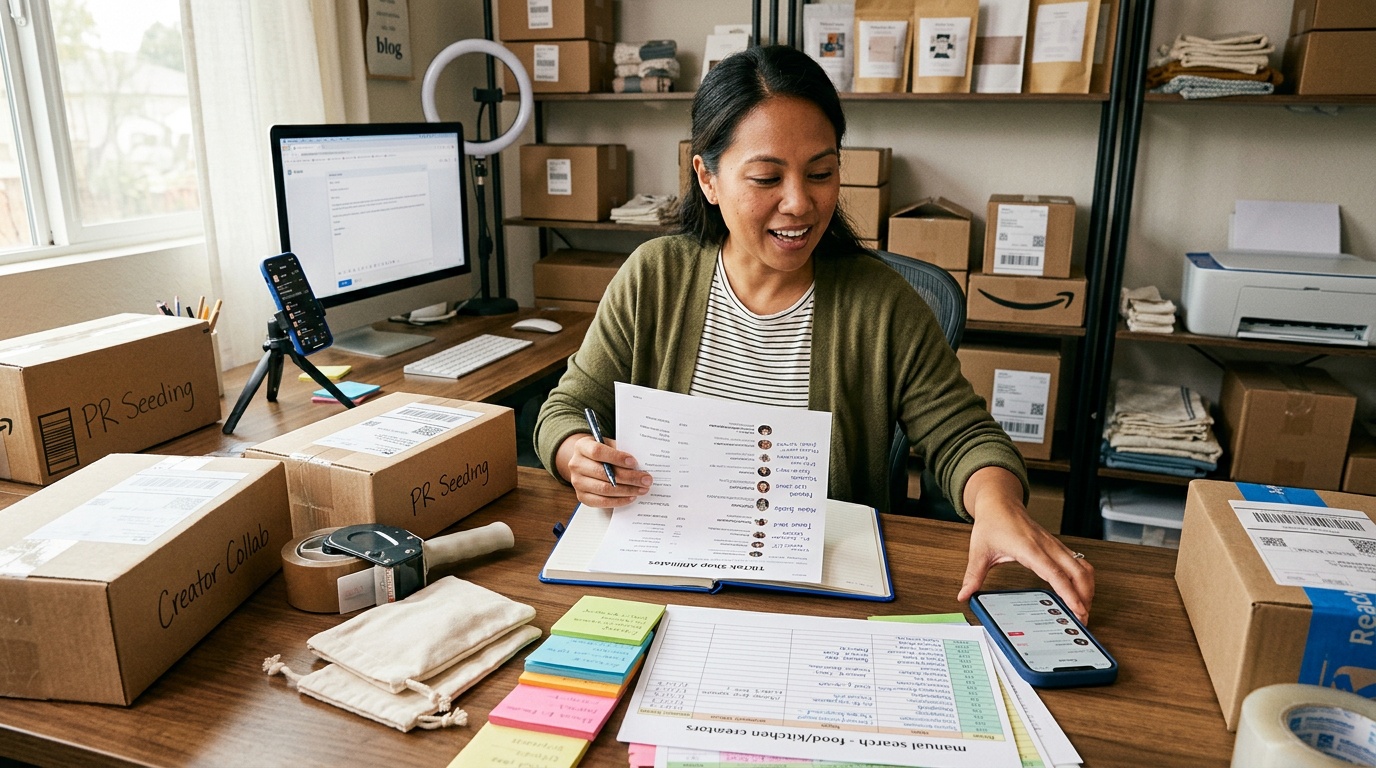
The difference between AI-powered creator discovery and manual search for TikTok Shop campaigns is measurable phase by phase. Manual research adds labor to defining criteria, finding candidates, validating fit, sending outreach, reviewing samples, and tracking revenue. AI-supported discovery gives each phase a data layer, allowing teams to focus more on negotiation, creative direction, and campaign optimization.
| Workflow phase | Manual search | AI-powered discovery with Reacher | Operational effect |
|---|---|---|---|
| Campaign definition | Teams create broad creator criteria from category knowledge and past experience. | Campaign goals, product price, audience profile, content style, commission structure, and sales threshold become searchable criteria. | Less ambiguity before prospecting begins. |
| Candidate discovery | Staff scroll hashtags, sounds, search results, and marketplace listings one profile at a time. | Signal-based matching narrows the pool using content relevance, audience behavior, category alignment, and commerce indicators. | Fewer profiles require manual review. |
| Qualification | Analysts inspect bios, views, comments, posting frequency, and visible engagement manually. | Creators are prioritized using multiple signals instead of a single follower or view count. | Better consistency across reviewers. |
| Outreach and samples | Cold DMs and broad sample offers create low response rates and unproductive shipments. | Teams contact a ranked group and apply approval rules before sending product. | Lower outreach waste and tighter inventory control. |
| Measurement | Results sit across affiliate reports, spreadsheets, listing counters, and individual conversations. | Creator activity, content output, sales signals, and relationship status can be managed within a repeatable workflow. | Clearer decisions about renewal and budget allocation. |
Phase 1: Defining Campaign Needs & Ideal Creator Profile
Manual programs may begin with “find beauty creators” or “find high-engagement affiliates,” leaving the target customer, content format, product price, commission ceiling, shipping capacity, posting window, and order volume undefined. A stronger brief specifies niche, audience geography, product use case, content style, and economic threshold before research begins.
Reacher turns these requirements into a qualification profile. The difference between AI-powered creator discovery and manual search for TikTok Shop campaigns starts here: candidates can be compared against consistent criteria tied to content, audience, and commercial objectives through AI creator search.
Phase 2: The Manual Scavenger Hunt: Hashtags, Sounds, and Creator Marketplace
Manual discovery searches hashtags, trending audio, product pages, comments, and the TikTok Creator Marketplace. Researchers open profiles, assess videos, note follower counts, and copy contact information into trackers. Each candidate requires separate context gathering. A creator may look relevant through a hashtag yet show little product content, weak audience alignment, or no affiliate activity.
The process also creates inconsistent judgments. One reviewer may favor views, another comments or posting frequency. Inbound DMs create the opposite problem: brands receive free-product requests from creators whose audiences may not match the offer. Manual search can find people, but does not reliably rank purchase probability.
Phase 3: AI-Powered Discovery: Signal Analysis and Predictive Matching
AI-supported discovery analyzes video themes, product references, audience interaction, publishing patterns, niche relevance, and commercial behavior. Not every predicted match will convert, but teams begin with a more informed shortlist instead of treating follower count as a proxy for sales.
Reacher’s matching workflow separates audience size from audience quality. A smaller creator with product demonstrations, useful comment activity, and category alignment may deserve attention before a larger account with broad but commercially weak reach. The practical difference between AI-powered creator discovery and manual search for TikTok Shop campaigns is prioritization based on wider evidence.
Phase 4: Initial Outreach & Vetting: The Sample Request Gauntlet
Cold outreach becomes expensive when discovery is weak. Without commerce-signal qualification, brands may send dozens of pitches and receive few replies. The eight-replies-from-40-pitches pattern reflects a basic constraint: a message cannot recover from poor creator fit. Unproductive exchanges consume staff time, and unqualified samples add shipping, inventory, and tracking costs.
Use a ranked funnel: review content relevance, confirm audience fit, check posting reliability, define deliverables, and approve sample fulfillment. Track invitations, responses, accepted samples, posted content, clicks, orders, and affiliate revenue separately. Free-product requests should not be mistaken for creator demand. A dedicated sample management workflow can help teams control fulfillment and approvals.
Phase 5: Performance Tracking & Relationship Management
Manual programs scatter data across spreadsheets, platform reports, messages, and listing dashboards. Views and likes show attention but do not prove incremental orders or gross merchandise value. A repeatable workflow connects creator, campaign, content, product, affiliate terms, sample status, and sales activity from invitation to purchase.
After discovery, Reacher’s Creator Community organizes participation through Discord-based creator community management and creator activation workflows. It supports announcements, education, content prompts, relationship history, and affiliate coordination. The difference between AI-powered creator discovery and manual search for TikTok Shop campaigns extends beyond finding names: it determines whether discovery becomes a measurable revenue process.
Unit Economics & GMV Tracking: Where Manual Search Bleeds Margins
Creator discovery becomes a margin problem when brands assess attention before economics. High views do not confirm product-market fit, buyer quality, or affiliate sales. Manual prospecting may send inventory to creators who accept samples but never publish, while staff chase replies and reconcile incomplete data. AI-supported qualification creates a clearer path from creator selection to gross merchandise value (GMV).
| Economic checkpoint | Manual search | AI-supported discovery with Reacher |
|---|---|---|
| Prospect cost | Staff time accumulates through profile visits, spreadsheets, cold DMs, and follow-ups. | Signal-based ranking concentrates review time on stronger campaign matches. |
| Sample control | Free-product requests may be approved before posting reliability or audience fit is verified. | Qualification criteria can be applied before inventory is assigned. |
| Performance evidence | Views, likes, listing counters, and messages often sit in separate records. | Creator activity, content delivery, affiliate results, and relationship status can be reviewed as one operating process. |
| Margin decision | Commission and fulfillment costs are often assessed after outreach begins. | Product price, expected order value, commission terms, and sales thresholds can shape the shortlist. |
The True Cost of a Cold DM: Sample Waste and Low Conversion
A cold DM carries research labor, copywriting, follow-up, sample packaging, shipping, inventory allocation, and reporting costs. Manual outreach often produces eight replies from 40 pitches, with typical response rates below 15% to 20% when prospects lack prior commerce-signal qualification. A reply still does not guarantee a posted video or an order.
Separate pitches sent, replies received, samples accepted, products shipped, content published, clicks generated, and orders attributed. A creator who requests free product but stops before publishing should not receive the same priority as an affiliate who consistently posts shoppable content. This protects inventory and exposes the acquisition cost of each converted order.
Measuring Real Impact: GMV Attribution vs. Vanity Metrics
GMV tracking requires attributed orders, gross sales value, refunds, cancellations, affiliate commission, product cost, fulfillment expense, and content output. Views indicate distribution, while comments may reveal product questions or buyer objections. Neither proves revenue without order data connected to creator, listing, campaign period, and affiliate link.
A practical formula is: net creator contribution = attributed GMV minus product cost, creator commission, fulfillment expense, sample cost, and campaign labor. This separates profitable reach from expensive exposure and supports renewal rules for creators whose order economics meet the campaign threshold. Teams can use P&L tracking for creator campaigns to connect performance with profitability.
Protecting Your Margins: Creator Commission Expectations & Product Price Fit ($40+ Focus)
Products priced at $40 or more can support a larger absolute commission while preserving contribution margin if conversion quality justifies the payout. Model selling price against landed cost, platform fees, affiliate commission, discounting, returns, and sample acquisition cost. A percentage commission can remove most available profit after fulfillment and promotional deductions.
Set a maximum allowable acquisition cost before outreach. If the campaign requires a defined contribution per order, sample expense, commission, and fulfillment must stay below that threshold. Manual search often postpones this calculation until after products ship. Reacher supports a disciplined shortlist, while Creator Community supports creator activation workflows and Community-led affiliate growth after qualified partners enter the program.
AI's Predictive Power: Identifying Creators Who Drive Actual Sales
AI does not replace order validation, but improves decisions made before inventory and staff time are committed. It compares content relevance, product demonstrations, audience interaction, publishing behavior, category alignment, and commercial intent across a large pool. That evidence is more useful than selecting creators solely by followers or viral reach.
The financial advantage is prioritization. Teams can reserve samples for creators whose audience and content indicate a credible buying path, then confirm performance through affiliate orders and GMV reporting. Reacher’s Creator Community extends that process into Discord-based creator community management, supporting active partners and repeatable affiliate revenue without treating every inbound request as an equal investment.
Beyond the Scroll: How AI Unlocks TikTok Shop's True Creator Potential
Follower count and visible engagement provide only a partial view of creator value. AI-powered discovery examines content, audience behavior, and commercial patterns that manual reviews may miss. The goal is to identify buying signals early, then validate them through tracked content and TikTok Shop sales.
Multimodal Intelligence: Analyzing Video Content, Not Just Bios
Multimodal analysis reviews spoken language, on-screen text, product demonstrations, visual format, audio selection, posting cadence, and recurring themes across videos. This shows whether a creator explains products, handles objections, demonstrates use cases, or mainly publishes entertainment content with limited commercial relevance.
A creator may have broad reach but little offer experience, while another consistently produces tutorials, comparisons, unboxings, or live-selling content. Reacher helps teams identify these patterns at scale before negotiations begin.
Audience Purchase Intent: Filtering for Buyers, Not Just Viewers
Audience quality appears in behavior. Comments about price, availability, sizing, ingredients, shipping, or performance can indicate stronger buying interest than passive likes. Product questions, saved-content signals, click activity, and creator-specific sales history add context for commercial intent.
AI organizes these signals with category fit and content relevance. A smaller account with a focused buyer community may offer better affiliate economics than a large account whose audience rarely discusses products. This helps brands reserve samples and commission opportunities for creators with a credible path from attention to purchase.
Operational Efficiency: From Hours of Scrolling to Minutes of Analysis
Manual research gathers the same information repeatedly across profiles, videos, comments, and spreadsheets. An AI-assisted workflow creates a consistent screening layer, allowing marketers to review ranked candidates rather than an unfiltered search page. Saved time can support offer design, creator briefing, sample controls, content review, and campaign testing.
Shared criteria also reduce reviewer bias and make approval, deferral, or rejection decisions easier to explain. That repeatability supports larger creator programs without adding the same proportion of administrative labor.
Why Reacher is Your Strategic Partner for Scalable TikTok Shop Growth
Reacher connects creator discovery with the systems needed after selection. Its Creator Community supports Discord-based creator community management, creator activation workflows, and Community-led affiliate growth. Qualified partners can receive guidance, campaign updates, creative prompts, and ongoing communication in one organized environment.
Use AI to prioritize commercial fit, validate performance through GMV and order data, then build participation through Creator Community. This model connects discovery, activation, measurement, and retention for TikTok Shop teams that need more than a list of names.
Frequently Asked Questions
How much time does manual TikTok Shop creator discovery take each week?
Manual TikTok Shop creator discovery consumes hours every week across hashtags, trending sounds, profiles, and direct messages. Each candidate requires opening profiles, watching videos, inspecting comments, and recording contact details before anyone can judge fit. That labor scales poorly once you are evaluating hundreds of creators for a single campaign.
Why are response rates so low for manual creator outreach on TikTok Shop?
Manual creator outreach produces low response rates because pitches go to unqualified prospects with no commerce-signal filtering. One reported benchmark showed eight replies from 40 pitches, and typical response rates stay below 15% to 20% without prior filtering. AI-powered discovery ranks creators by purchase intent first, so outreach targets stronger-fit candidates.
What signals does AI-powered creator discovery evaluate that manual search misses?
AI-powered creator discovery evaluates audience behavior, content patterns, product category alignment, commerce history, and campaign fit together, while manual search for TikTok Shop campaigns relies on follower counts, views, hashtags, and public bios. Surface metrics rarely show whether an audience actually buys. Structured qualification happens before any sample request or affiliate invitation goes out.
How much do fake followers and inauthentic creator partnerships cost brands?
Brands lose an average of $250,000 annually to inauthentic partnerships and fraudulent followers, according to InfluenceFlow. Manual search struggles to catch this because follower counts and view totals hide audience quality problems. Signal-based evaluation identifies weak partnerships before your inventory and outreach capacity get wasted on them.
Can AI creator discovery tools integrate with existing TikTok Shop affiliate workflows?
Reacher offers custom workflow support and affiliate data integration, so discovery connects directly to your existing TikTok Shop operations. Teams can build on Reacher's creator and GMV data via API to move qualified creators into reporting and activation. Relationships stay managed in one repeatable workflow instead of scattered across spreadsheets and inboxes.
How does AI handle inbound creator DMs and free product requests?
Reacher's inbound message automation auto-replies to creator messages in your brand voice, so every request gets a fast, consistent response. Manual programs field waves of free-product requests from creators whose audiences rarely match the offer. Automated brand-voice replies plus ranked outreach protect both your team's time and your inventory.
What happens to creators who never reply to a TikTok Shop campaign pitch?
Reacher's creator re-engagement automation automatically wins back creators who stalled or never replied to your first outreach. Manual programs usually abandon these contacts because follow-up takes staff hours nobody has to spare. Automated re-engagement recovers that pipeline without adding labor to your weekly workflow.