
Reacher Stephen
Amazon Influencer Program Apply: Requirements, Storefront Setup, and Approval Walkthrough
Learn how to apply for the Amazon Influencer Program, pass social account review, unlock onsite commissions, and launch your Amazon storefront.

amazon influencer program apply
If you want to amazon influencer program apply successfully, treat the process as a social account review before a storefront setup. Amazon assesses public content, audience activity, and account quality before granting influencer tools. This guide covers application preparation, profile problems, approval stages, account differences, storefront setup, onsite commissions, and realistic early income.
Key Takeaways
- Your application depends on a strong public social presence, not just your Amazon history, because Amazon reviews your content quality and audience engagement before approving you.
- Focus on polishing your public profiles and posting consistent, authentic content to pass the social account review, the first gatekeeper in the approval process.
- Understand the difference between Amazon Influencer and Associate accounts, as the Influencer tier grants onsite commissions and storefront tools that Associates don't get.
- Set realistic income expectations from the start, since early earnings from the program rarely match viral success stories and require strategic content placement.
- Troubleshoot common profile problems like low follower counts or inactive feeds before you submit, because Amazon looks for signal that you can drive actual sales.
The Amazon Influencer Program differs from Amazon Associates, and storefront approval does not automatically grant onsite commissions. Use free official resources before paying for a course, and consider the Reacher Affiliate Program when you want a structured way to recommend useful marketing resources.
Unlock Your Earning Potential: Navigating the Amazon Influencer Program Application
Sign in through Amazon’s official influencer application flow with an eligible TikTok, YouTube, Instagram, or Facebook account. Amazon reviews that social presence before approving your public storefront. After approval, you can organize product recommendations, publish content, and earn from qualifying purchases. Onsite commissions require a separate review of three uploaded product videos.
Understanding the Amazon Influencer Program: Beyond Basic Affiliation
The program is for creators who influence shopping decisions through social content. It provides a vanity URL, curated storefront, idea lists, and video-based product discovery. Amazon Associates centers on tagged links that send shoppers to Amazon. The influencer route reviews your social profile upfront and adds creator merchandising tools.
Why This Guide is Your Blueprint for Success
A storefront approval is only the first gate. Your application needs a public profile with recent, original posts, a clear subject area, and visible audience interaction. Later, your video submission needs clean framing, understandable audio, accurate product use, and no unsupported medical promises.
Setting Realistic Expectations: The Two-Tier Approval & Earning Curve
The process has two approval levels. First, Amazon decides whether your connected social account qualifies for the influencer program and storefront access. Second, it reviews three product review videos for onsite placement. Treat early income figures as planning benchmarks, not guarantees. Product category, traffic quality, publishing volume, conversion rate, and content usefulness determine actual commission.
Amazon Influencer Program Eligibility & Social Account Setup: Your First Hurdle
Core Eligibility Criteria: What Amazon Looks For
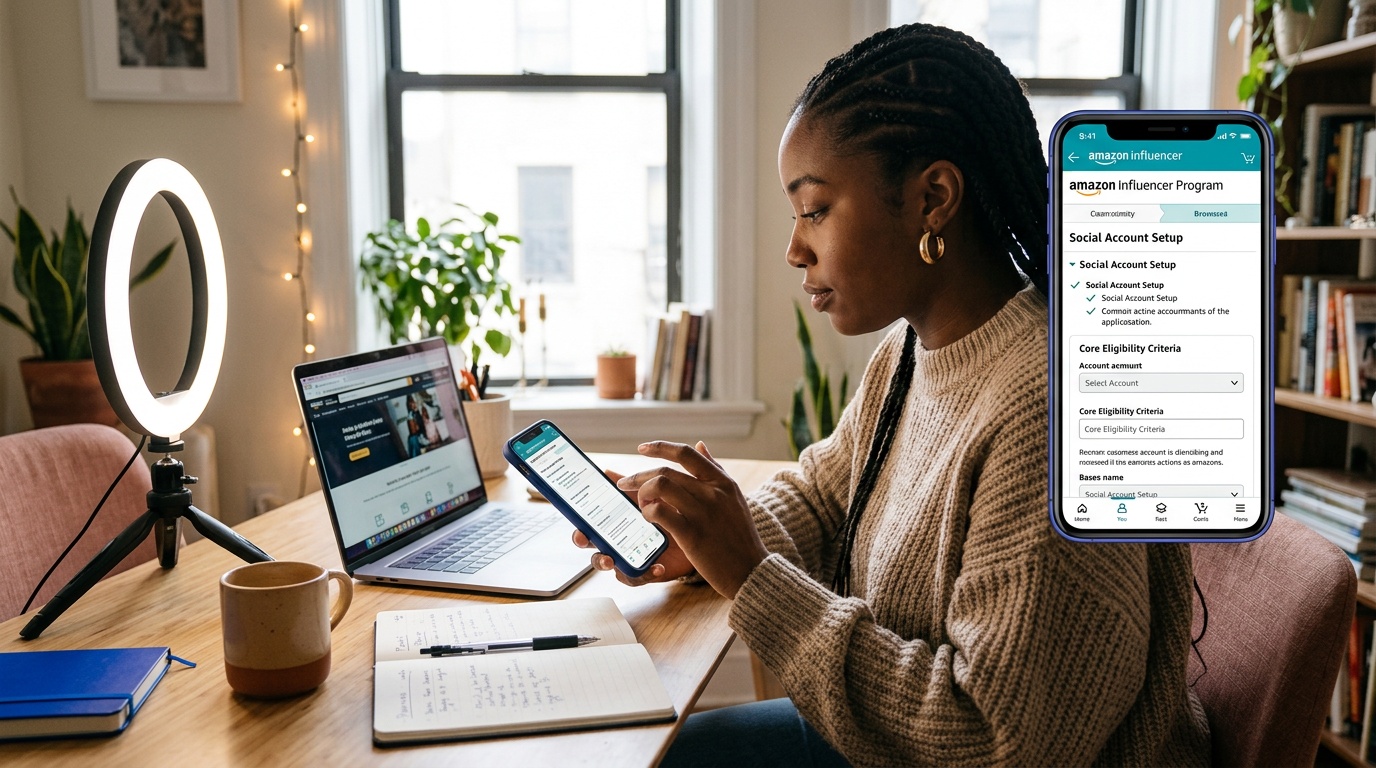
Amazon does not publish one universal follower minimum that guarantees acceptance. Reviewers look for an account that is public, active, authentic, and connected to a real creator identity. Prepare original posts, a consistent topic, visible comments or other audience signals, and a bio explaining your content. Before you begin the amazon influencer program apply process, make your social handle, display name, and contact details consistent.
Platform-Specific Requirements: TikTok, YouTube, Instagram, and Facebook Deep Dive
TikTok applicants should show public videos with genuine viewer interaction and a recognizable content theme. YouTube applicants should present a public channel with published videos. Instagram applicants should use a public creator or business profile with visible posts and meaningful activity. Facebook applicants need a public page or profile showing original publishing and audience engagement.
The Myth of Follower Counts: Why Engagement is King
A large audience does not repair weak content. A smaller account with recent posts, relevant comments, repeat viewers, saves, shares, and clear product discussion can present a stronger application than a large account with dormant followers.
Optimizing Your Social Profiles for Application Success
- Use a public profile with a clear profile photo, creator name, and niche description.
- Publish original content consistently before applying.
- Remove broken links, misleading claims, recycled media, and posts with unclear ownership.
- Keep comments open where appropriate, and respond naturally to audience questions.
- Make strong product demonstrations easy to find through playlists, pinned posts, or organized highlights.
Connecting Your Social Accounts: A Step-by-Step Walkthrough
Start at Amazon’s official influencer page and select the application option. Sign in with the Amazon account you intend to manage long term, choose the social platform that best represents your active audience, authorize requested permissions, confirm the displayed handle, and check the profile Amazon pulls into the form. Submit only after confirming that the account is public and correct.
Troubleshooting Common Application Rejections & Reapplication Strategy
Rejection can follow low activity, private visibility, unclear account ownership, copied content, weak audience interaction, or a profile that gives Amazon too little evidence of an active creator business. First make the account public, publish stronger original content, correct the bio, remove policy-sensitive claims, and verify the selected handle.
Mastering the Amazon Creator Hub: Storefront Setup and Onsite Commission Readiness
After you complete the amazon influencer program apply process and receive storefront access, organize the creator workspace. The Amazon Creator Hub connects your storefront, idea lists, shoppable videos, earnings data, and account settings. A clear structure helps shoppers find relevant recommendations, while accurate tracking links protect affiliate attribution.
Navigating the Amazon Influencer Login and Creator Hub Portal
Use the Amazon account associated with your approved social profile to access the Amazon influencer login. Amazon may route you through the Creator Hub, Associates Central, or your Amazon storefront login. Check the account email, creator name, and storefront handle before changing settings.
Building Your Amazon Storefront: From Basics to Branding
Choose a storefront identity that matches your public creator account. Add a profile image, concise bio, and recommendation groups organized by shopper need. Useful themes include apartment organization, beginner camera equipment, travel accessories, kitchen tools, or products tested during a routine. Give each list a clear title, explanation, and products that belong together.
For creators learning how to create an Amazon storefront as an influencer, open storefront editing, update profile details, create an idea list, add qualifying products, write annotations, and publish the changes. A structured creator community for collaboration and learning can also help creators develop a repeatable content plan.
Creating Shoppable Content: Idea Lists, Pins, and Videos
Build each asset around a shopping question. Idea lists organize products, pins direct attention to a recommendation, and videos demonstrate use, scale, texture, setup, or results. Film vertically with steady framing, clear speech, and enough product detail to identify the exact item.
Understanding Onsite Commissions vs. Offsite Affiliate Links: The Earning Difference
Storefront approval does not automatically activate onsite commissions. Amazon requires three product review videos for manual placement review. Upload three distinct videos showing product knowledge, accurate identification, and practical buyer guidance. Use clean audio, stable lighting, readable product views, and a vertical composition suited to mobile viewing.
Creator Hub Workflow: Tracking Performance and Affiliate Attribution
Use reporting to separate clicks, ordered items, shipped items, conversion activity, and commission earnings. Review performance by product, format, idea list, and traffic source where available. A video with many views but few product-page visits may need a clearer recommendation.
Beyond the Application: Realistic Earnings, Creator Connections, and Scaling Your Revenue
Storefront approval gives you access, not guaranteed income. Income depends on product category, viewer intent, publishing volume, conversion rate, traffic quality, and qualifying purchases.
The Real Earning Curve: Navigating Initial Income and Growth Trajectories
Early earnings often remain modest because a new catalog has limited discovery and few data points. Publishing more videos does not guarantee sales, so focus on buyer usefulness. Demonstrate setup, size, compatibility, maintenance, and limitations.
Leveraging Creator Connections: Direct Brand Partnerships and Opportunities
Creator Connections can add revenue through campaigns connecting creators with participating brands. Read each offer carefully and confirm the content format, deadline, commission terms, disclosure language, product eligibility, and approval conditions.
Developing a Content Strategy for Sustained Commission Growth
Build a repeatable system around discovery videos, demonstration videos, and decision videos addressing fit, limitations, or alternatives. Organize a calendar by shopper problem, not only product name.
Maximizing Your Storefront's Visibility and Traffic
Drive qualified visitors from channels where your audience already pays attention. Use a direct storefront link in your profile, reference relevant idea lists in captions, and connect each video to a specific shopping need.
The Reacher Advantage: Streamlining Creator Management for Brands
Brands need organized creator discovery, outreach, approvals, deliverables, and relationship records. Reacher’s creator CRM for managing creator relationships can help teams centralize campaign details and review which partnerships produce qualified attention rather than relying on impressions alone.
Scaling With Discipline: Benefits and Tradeoffs
Pros
- More published content creates additional discovery opportunities.
- Performance data helps identify profitable categories and formats.
- Creator partnerships can add campaign income beyond standard commissions.
Cons
- Early production time may exceed initial earnings.
- Commission rates and product availability can change.
- Higher volume without quality control can weaken audience trust.
Use the amazon influencer program apply process as the starting point for a measured publishing business. Set a 90-day review point, track content-level attribution, and increase production only after identifying formats that help shoppers make confident decisions.
Frequently Asked Questions
How do I get approved for the Amazon Influencer Program?
Amazon Influencer Program approval requires a public, active, authentic TikTok, YouTube, Instagram, or Facebook account connected through Amazon’s official application flow. Use a clear creator profile, recent original posts, a defined topic, and visible audience interaction. After storefront approval, Amazon separately reviews three product videos for onsite commission eligibility.
How much do Amazon influencers get paid?
Amazon influencers earn commissions from qualifying purchases made through their storefronts, idea lists, or approved content. Earnings vary by product category, traffic quality, conversion rate, and publishing volume, so no fixed monthly amount applies. Onsite commissions require separate approval after Amazon reviews three uploaded product videos.
Can I make $1,000 a month with the Amazon Influencer Program?
Amazon Influencer Program members can make $1,000 a month, but Amazon does not guarantee that income level. Reaching it depends on product demand, commission rates, shopper traffic, conversion performance, and consistent content publishing. Early earnings may be modest while you test product categories, formats, and audience response.
How many followers do you need to be an Amazon influencer?
Amazon does not publish one universal follower minimum for Influencer Program approval. Amazon reviews whether the connected account is public, active, authentic, and supported by meaningful audience activity. A smaller account with recent original content and genuine engagement may qualify, while a large inactive account may not.
Is being an Amazon influencer worth it?
Being an Amazon influencer can be worthwhile for creators who already publish product-focused content and can consistently guide shoppers to useful recommendations. The program provides a storefront, idea lists, and video shopping tools, but income is performance-based. Review the free official resources first and treat approval and earnings as separate milestones.